Chavs by Owen Jones
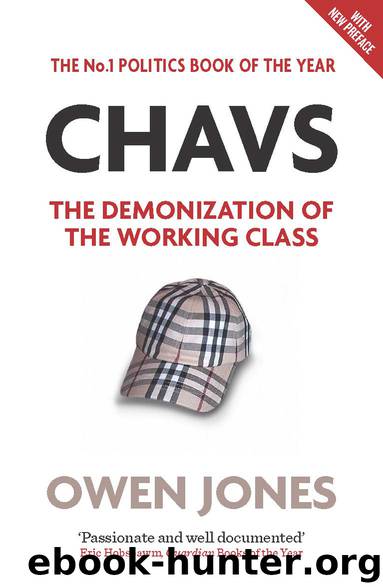
Author:Owen Jones
Language: eng
Format: epub
Tags: CHAVS The Demonization of the Working Class
ISBN: 9781844678044
Publisher: Verso Books
Published: 2011-04-15T04:00:00+00:00
The contempt for working-class people that built up under Thatcherism had reached its terrible zenith in the Hillsborough Disaster. Today, football continues to offer clues to the dramatic change in attitudes over the past three decades. By looking at what has happened to the traditional sporting passion of working-class Britain, we can get a good idea of the cultural impact of chav-hate. The ‘beautiful game’ has been transformed beyond recognition.
Although major clubs shifted away from their origins long ago—for example, Manchester United was founded by railwaymen—they remained deeply rooted in working-class communities. Footballers were generally boys plucked from the club’s local area. Unlike the spoiled plutocrats that some Premier League players have become, for much of the twentieth century ‘footballers were often worse off than the crowds watching them from the terraces on a Saturday,’ as footballer Stuart Imlach’s son has written.48 Back in the early 1950s, there was a maximum salary for players of just £14 a week during the season—not very much over the average manual wage—and only one in five players were lucky enough to earn that. Players lived in ‘tied cottages’—houses owned by clubs from which they could be evicted at any moment. Little wonder one footballer, speaking at the 1955 Trades Union Congress, complained that ‘the conditions of the professional footballer’s employment are akin to slavery.’
Football has gone from one extreme to another. The cold winds of free-market economics had largely been kept out of the football world during the 1980s. In the 1990s, they hit with a vengeance. In 1992, the twenty-two clubs of the old First Division broke away to establish the Premier League, freeing them from the requirement to share revenues with clubs in the rest of the League. Part of the new commercial ethos was to keep many working-class people out of the stadium. In its Blueprint for the Future of Football, the Football Association argued that the game must attract ‘more affluent middle-class consumers’.49
When the old terraces were abolished after the Hillsborough Disaster, the cheaper standing tickets disappeared. Between 1990 and 2008, the price of the average football ticket rose by 600 per cent, well over seven times the rate of everything else.50 This was completely unaffordable for many working-class people. But some senior football figures were not only aware of this—they even celebrated it. As former England manager Terry Venables put it:
Without wishing to sound snobbish or to be disloyal to my own working-class background, the increase in admission prices is likely to exclude the sort of people who were giving English football a bad name. I am talking about the young men, mostly working-class, who terrorized football grounds, railway trains, cross-channel ferries and towns and cities throughout England and Europe.
The demonization of working-class people was being used to justify hiking up ticket prices and, in the process, to keep them out.
At the same time, football became big money—and big business. In the early 1990s, Rupert Murdoch’s BSkyB signed an agreement to pay £305 million for exclusive rights to the new FA Carling Premiership.
Download
This site does not store any files on its server. We only index and link to content provided by other sites. Please contact the content providers to delete copyright contents if any and email us, we'll remove relevant links or contents immediately.
| Anthropology | Archaeology |
| Philosophy | Politics & Government |
| Social Sciences | Sociology |
| Women's Studies |
Nudge - Improving Decisions about Health, Wealth, and Happiness by Thaler Sunstein(7712)
The Fire Next Time by James Baldwin(5454)
iGen by Jean M. Twenge(5419)
Adulting by Kelly Williams Brown(4582)
The Sports Rules Book by Human Kinetics(4396)
The Hacking of the American Mind by Robert H. Lustig(4387)
The Ethical Slut by Janet W. Hardy(4262)
Captivate by Vanessa Van Edwards(3843)
Mummy Knew by Lisa James(3695)
In a Sunburned Country by Bill Bryson(3546)
The Worm at the Core by Sheldon Solomon(3490)
Ants Among Elephants by Sujatha Gidla(3469)
The 48 laws of power by Robert Greene & Joost Elffers(3299)
Suicide: A Study in Sociology by Emile Durkheim(3025)
The Slow Fix: Solve Problems, Work Smarter, and Live Better In a World Addicted to Speed by Carl Honore(3014)
The Tipping Point by Malcolm Gladwell(2930)
Humans of New York by Brandon Stanton(2876)
Get What's Yours for Medicare: Maximize Your Coverage, Minimize Your Costs by Philip Moeller(2763)
Handbook of Forensic Sociology and Psychology by Stephen J. Morewitz & Mark L. Goldstein(2709)
